Category: General

  • What would AI highlight in your annual summary?

    What would AI highlight in your annual summary?

    Everyone is talking about artificial intelligence these days. What if we turned the topic around for a moment, and for the sake of your own development, you thought about what AI would say about your year?

    I recently got an email saying my LinkedIn Rewind was ready, an AI-generated summary of my year. I have never been a big fan of mass-produced content like this (apologies to the people who make it), but the mention of AI gave me a really good idea.

    In coaching we often ask questions that nudge the client to shift perspective and look at their situation from another angle. The goal is for the person to arrive at new insights and ideas. To get there, we often play with the thought of what someone else would say about the situation. How would they tell the story? What would they suggest as a solution?

    And here is where my idea came in. LinkedIn offers a summary of our 2025 that AI creates for us. How great would it be to think through for ourselves what AI would highlight from our 2025?

    So here is the question: what would AI highlight in your annual summary this year?

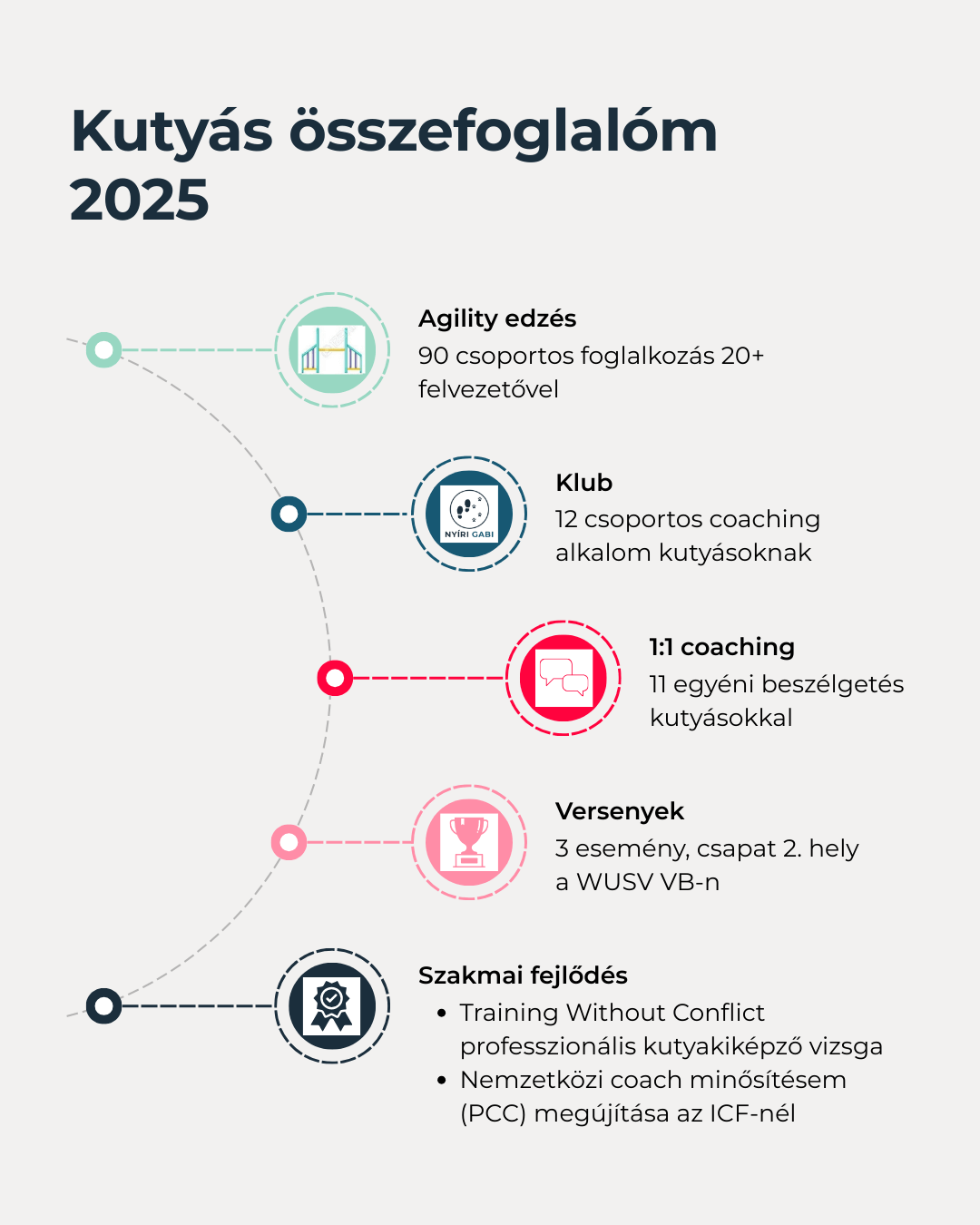
    My dog person summary of 2025, made by hand in Canva

    Something like this could be your prompt:

    You want to create a summary of your year 2025 that includes your defining achievements and experiences. Consider all the areas of your life that matter to you. The goal of the exercise is to pause for a moment, look back, collect the important moments, celebrate, and feel gratitude.

    The picture above is my AI-inspired dog person summary of 2025, made by hand in Canva. Now it is your turn!

  • E-book reloaded

    E-book reloaded

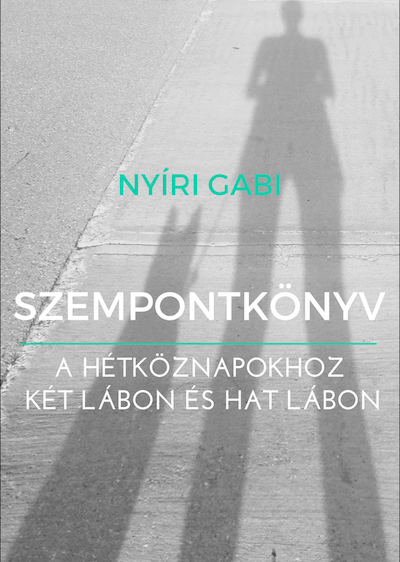
    My first piece on personal development for dog people came out 9 years ago. An anniversary deserves a gift! Here is the Perspective Book for Everyday Life on Two Legs and Six Legs. Download it now!

    First of all, here is the e-book. After that, I will tell you how all of this, personal development for dog people, got started.

    Cover of the Perspective Book for Everyday Life on Two Legs and Six Legs

    Click here to download the e-book (the e-book is in Hungarian).

    It started with me noticing something. I noticed that the same themes often came up in agility training and in corporate trainings, the two places where I worked on people’s development.

    So I started looking consciously for how the attitude and skills we pick up in life with dogs can be successfully extended to other areas of life. That is how the blog was born. Exactly 9 years ago my first piece on personal development for dog people was published.

    Along the way the whole thing took several forms, but the goal never changed: helping dog people flourish through the very thing that makes them love life with dogs so much.

    • The Inner Circle was born, the newsletter that makes sure you never miss any news. If you have not yet, you can subscribe here.
    • I also launched the Always Be a Dog Person Club, which gets you started and keeps you going on the path of consciously extending what already works well in your life with dogs to other areas of your life. Besides learning with me live every month, I support your growth with plenty of extras. Details about the Club here.

    I also like to say that personal development for dog people includes my own path. When I write that 9 years ago the whole thing suddenly took off and then grew with this and that, it may sound as if it all went smoothly and by itself. In reality there was a huge amount of learning and inner work in the background. As it matured, what I believe about flourishing became a system. And the details I first discovered still hold up today.

    That realization is the gift I received for this anniversary. I had been wondering for a while what your gift could be, and that led me to the old materials I had set aside. I started going through them: is there anything here that can add value now?

    And I was honestly happy to see that there is. I wrote the Perspective Book during the first year, and I am handing it over to you with love. Enjoy flipping through it!

  • Is everyone watching us? No!

    Is everyone watching us? No!

    Since you have not worried yourself sick over me during the last six weeks, it is worth talking about how much other people think about you.

    • You did not worry yourself sick that I have not published a new long post in recent weeks. It crossed my mind that you might have, of course, even though you most likely did not even notice.
    • This is only interesting because, due to a cognitive bias, you may overestimate in exactly the same way how much your surroundings think about you, and especially about your missteps.
    • That can create tension and bad feelings, which can even lead you to keep away from all sorts of social situations so you do not land in something embarrassing.

    Read on for the details. You cannot fully opt out of the bias, but you can become aware when the process kicks in and step away from it.

    The talk, in writing

    In this episode I would like to talk about how much we think about each other. More precisely, about what we think about how much others are occupied with us.

    Let me start by giving away the punchline and bringing the scientific explanation first. There is a cognitive bias called the spotlight effect. It says that people consistently overestimate how much others pay attention to them and think about them. That is really interesting, because everyone’s mind works in a way that it is busy with its own behavior, its own thoughts and the impression it makes on others, and with a clever move it projects that straight onto its surroundings. So we assume that others think about us exactly as much as we think about ourselves.

    It follows that people become incredibly sensitive about the idea that every eye and every bit of attention is surely on them, in every situation. Even after a situation is over, we imagine everyone is still replaying how we behaved. And this becomes especially painful when things do not go perfectly.

    Something embarrassing happens and we feel awful about it. To exaggerate a little, we feel the ground opening under us and we are going to sink with shame. Say we bombed a presentation, or noticed too late that we had gotten food all over our sweater at home and strolled around the office like that all day. That we feel bad about it is one thing, but we also assume that everyone else is surely busy with it constantly and gossiping about it. That creates a huge tension in us, which can lead to anxiety and to keeping ourselves away from all kinds of situations so we do not land in something unpleasant.

    The reason I am bringing this phenomenon to you is that it recently came up in a workplace conversation, and it showed not only that someone can make themselves feel bad with it, but that it can have a negative effect on relationships too. A manager told me that their team received a request from a sister department: “Listen, guys, we are working on a project and we would need your help. It would be great if you could do this for us this week.” The request reached the team somewhere around the middle of the week, maybe on Wednesday. They knew they were incredibly busy, since they were working on loads of things anyway. When the request came, they immediately thought that someone could only imagine they could take on this much extra work if they saw them as doing nothing and twiddling their thumbs. And how untrue that is! How unfair that nobody here appreciates them, and the rest of the company can choke on it.

    The manager tended to empathize with the team, and thought they surely were not standing up for their people enough toward the other departments. So the drama started to build. That is when I told them: listen, you are falling right into the spotlight effect. The story is not that anyone thinks you do not work. With a little exaggeration, they are not thinking anything about you, because they are busy with their own project. They simply need some help from you. And you are focused on “we are incredibly busy anyway, and if anyone does not see that, shame on them.” So things started to derail. Everyone was busy with their own stuff, and meanwhile a projection was born: that the other person should know exactly as much about what I am up to as I do.

    And how do I come into this? And why did I say in the intro that it is worth talking about, if you did not worry much about me in the last six weeks? Because I played the whole thing out in miniature myself.

    Maybe you know that I usually work in a way that every week I make a longer-format piece like this one, where I talk about some dog-related personal development topic. In the last six weeks I did not make one. I know that, and most likely nobody but me noticed. Yet the whole world could easily find out by going to my website and seeing that, yes indeed, nothing new has appeared in recent weeks.

    In my worse moments it crossed my mind that surely everyone is busy with the fact that Gabi has not put out any new material in six weeks. In my inner monologue I even got as far as thinking that you must be so disappointed in me that it wipes out the value of the past nine years, and I should go hide. I had to remind myself: look, this matters, at most, to me. People are doing perfectly well with all the material they find on social media. And they read through the posts of past years when they need to. But even I, who live and breathe conscious thinking and handling cognitive biases, can fall for this.

    Okay, so you understand that we have a tendency to overestimate how much others deal with us. Now comes the question: fine, but how do I unsubscribe from that? Cognitive biases have the property that they are built into how our mind works. You cannot say, thank you very much, I do not want the spotlight effect anymore, I withdraw my consent. Instead you have to learn to catch it when it happens. You can do that really well by making yourself aware of how little you actually think about others.

    Just try this little exercise: think back on how many boring presentations you have sat through in your life. Probably quite a lot. And how many times you were sure the speaker did not mean to say what came out of their mouth. Maybe you even had a laugh together. Or when did you last see a typo in an email, a mistake in a report, a dog bolting out of the dog run? And you still do not lie awake at night about it. It does not weigh on you what a silly spot the person got themselves into. You simply move on.

    And please, please build into the way you work that when you start to feel really terrible (pardon the strong word, I use it on purpose), when you start spinning up about oh my god, what will others think, then pull out the knowledge that you also think next to nothing about others. At least nowhere near as much as you are assuming is happening with you.

    So take this away from this episode: our mind is built to overestimate how much others deal with us. That tends to create tension and bad feelings in us. You cannot fully opt out of it, but you can become aware when the process kicks in and step away from it.

  • Anniversary dog

    Anniversary dog

    Well, more precisely, an arrival anniversary. Skill came to us 10 years ago today. Since he is a shelter dog and we do not know his exact birthday, we celebrate the anniversary of his arrival.

    He brought a lot of changes, but some things have stayed constant ever since.

    He settled in at lightning speed. When we set off for home from the shelter, he hopped into the crate next to Elfie, so they first traveled in the car just as they always did afterward.

    Once in the garden, Elfie gave him a tour. They walked along under the thuja trees and the fence, and not even half an hour later Skill was already out barking at the arriving pizza courier. After all, he lived here now.

    He was not called Skill back then. We do not know what he was called before. There was a name in his vaccination booklet, but probably nobody at the shelter had bothered to say it to him. So he learned that it is polite to sit when food is served from Elfie, though maybe only the next day.

    He arrived on Saturday, and by Sunday he was coming with me to the dog school to teach a class. We figured he knew about that exactly as little as he knew about staying home alone.

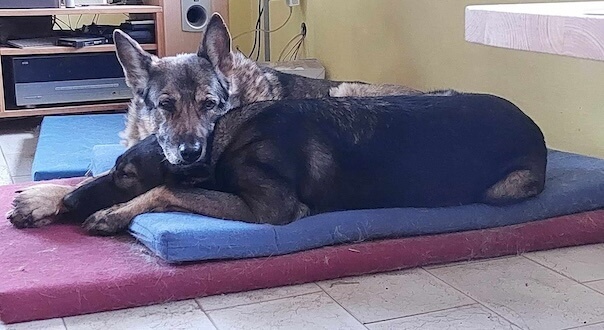
    He had long-running projects. Skill is a cuddly dog who wanted to practice that on Elfie too. It took at least a year. Until then, every blessed day he showered Elfie with affection and endured her grumpy looks and her pulling away. Piece by piece he wore down her resistance, and got Elfie to first tolerate face licking with an expression of “yuck, fine, just this once”. After that things escalated to the point that they slept cuddled up together. Sometimes.

    He was an only dog for 8 months too. After Elfie left us, it was just him. He held his ground heroically: he ate all the food, collected all the cuddles and chased every ball. But it was clear this was not his world.

    Skill the dog

    Then he raised Sage. From the moment we brought him home, Skill watched his small and sometimes annoying buddy with a proud look. He had a playmate again. Skill cannot run around because of his bad joints, but with breathtaking enthusiasm he stands still in the garden and gets the puppy to run circles around him (who is no longer a puppy, but the setup has not changed at all). An undeniable advantage of raising the puppy for Skill is that the little one could be shaped from a snapper into a snuggler. They sleep beautifully together in one bed. For a while, anyway, because everyone needs personal space, of course.

    What the years have not touched is his ball mania and his drive to work.

    His reputation as a retriever preceded him. We even went to the shelter intending to make sure he would not guard his prize from the other ball-crazy dog, Elfie. Yes, I was the one who tested the ball on the zeroth shared walk. And since there was no problem, we dared to start our shared life.

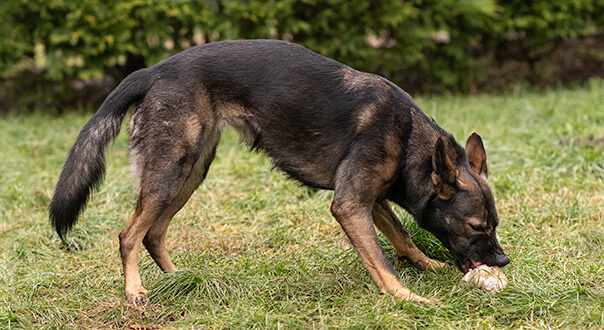
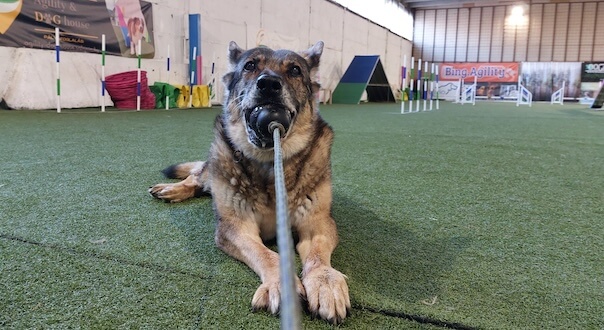
    Skill with his ball, photographed on his anniversary

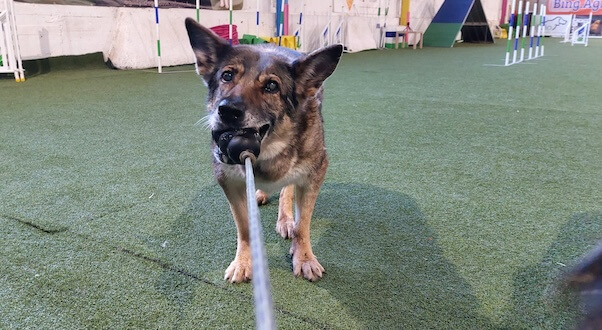
    The photo of him tugging the ball was taken today. It is still the best party: hanging off the equipment.

    Perhaps the biggest challenge with Skill is that his “let us do something” attitude has not changed, even though, in short, he does not have a single healthy joint. Today’s photo was also taken in the hall where Sage and I train. Surely nobody imagines that Skill does not come along. Just to avoid misunderstandings, when we have training gear with us, he positions himself significantly in the gateway, so nobody goes anywhere from here without him.

    His range is about 150 meters now, that is how far he can walk. In his head, of course, he is not tired by it. Standing for longer is already hard, and sitting only on good ground, if absolutely necessary. So a good part of the tricks drops out. But by now I can make a self-control task out of almost anything, as long as his ball can be placed next to it.

    This is him, the unity of change and constancy. Skill, we are so glad to have you!